Site Search
Search within product
第760号 2024(R06).05発行
Click here for PDF version
§園芸作物の光応答反応と農業技術(2)
-その他,花・野菜への光照射と花成制御の理論的背景-
Former Graduate School of Natural Science and Technology, Okayama University
桝田 正治
§愛知県における農作物鳥獣被害防止対策の取組
Agricultural Promotion Division, Agricultural Policy Department, Agriculture and Fisheries Bureau, Aichi Prefecture
Wild Boar Control Room
辻井 修
§土のはなし-第31回
危機に瀕する世界の土-その1
古代文明の崩壊と土の劣化
前 ジェイカムアグリ株式会社
北海道支店 技術顧問
松中 照夫
Light response response of horticultural crops and agricultural technology (2)
-その他,花・野菜への光照射と花成制御の理論的背景-
Former Graduate School of Natural Science and Technology, Okayama University
桝田 正治
1. electric irradiation of horticultural crops
(1) Flowers and plants
Flowering promotion by daylength control has been demonstrated in many long-day flowering plants, and LEDs are replacing incandescent and fluorescent lamps as the light source. The most common cut flowers are the cassia, stock, lisianthus, and snapdragon. The shuukon kasumisou has long demonstrated its uniqueness as a floral arrangement, or so-called "garnish flower. Its flowering is not promoted by red light, but by far-red light, which is more effective when added to red light, and it can be grown year-round in many prefectures. The effect of far-red light is also observed in stock.1)The following is a list of the most common problems with the "C" in the "C" column.
ストックの需要は年末から3月とされ,千葉県は全国一位で約10億の生産額を誇る。アイアン系の1本立ち主力品種では9月中旬から16時間日長となるよう遠赤色LEDの電照が開始される。
トルコギキョウも,遠赤色光によって花成と茎伸長が促進される2)The flower buds are not dead. In Kumamoto Prefecture, winter production of flower buds has been reported to suppress flower bud blasting, a phenomenon in which well-developed flower buds die off. Red light has little effect. In Chiba and Saitama prefectures, the use of red LEDs before and after picking (all-night illumination) seems to have been established as a crop type for fall emergence.3,4)The following is a list of the most common problems with the "C" in the "C" column.
キンギョソウも遠赤色LEDに反応し,摘心時より日長延長(16時間)あるいは3時間の暗期中断が一般に行われる5)The results of this study show that the use of far-red LED irradiation is a good technique to promote flowering and stabilize cut flower production. In summary, it can be seen that electric illumination with far-red LEDs is a technique that promotes flowering and contributes to stabilization of cut flower production in crops with relatively long days.
2) Vegetables
Compared to flowers, electric irradiation of vegetables is rare, except for shiso (Perilla frutescens), whose leaves are used to produce products while flower buds are suppressed. It was reported in Miyazaki Prefecture 30 years ago that shiso, a typical short-day plant, is highly effective in suppressing flower buds even with a one-hour interruption of the dark period.6)Spinach is a long-day plant. Spinach is a long-day plant, but Narimatsu7)showed that incandescent light with a daylength of about 13 hours in the fall and winter can increase volume without affecting flower growth. Recently, Yamazaki8)は,赤色LEDの2時間照明により品種‘ミラージュ’の葉面積が大きくなること,明け方の照明は真夜中の照明と比べて花茎伸長を抑制するとした。
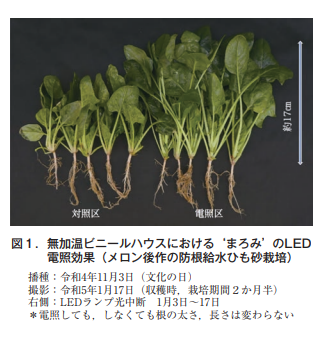
この報告は栄養成長を促す暗期中断の時刻について,暗期の中心以降に光照射の技術が存在すること,同時に電照効果は長日に鈍感な晩抽性の品種でより強く発現する可能性を示唆するもので,先に述べたキク暗期中断の時刻(Max)を念頭に秋冬期ハウスホウレンソウの草勢強化を図ることは,とりわけ生育緩慢な70%シュウ酸低減の新品種‘まろみ’(2022年発売,トーホク種苗)には必要ではないかと筆者は考えている(図1)。
2. ultraviolet and yellow LED irradiation
1)UV-B照射によるイチゴのうどん粉病とハダニの抑止効果
紫外線(UV-A:315~400nm)は,地表に到達する紫外光のほとんどを占め,ナスやプリムラマラコイデスの色素生成に必要なことは,古くから知られている。例えば,ナスの色素ナスニンは 370nm付近の光が必要とされ,それを遮断するガラス室での栽培では色付きが悪くなる。また, UV-B(280~315nm)は,バラのうどん粉病やハダニを抑制するが,イチゴでも紫外線の照射効果は高く,農研機構中央農業研究センターは多くの研究機関を統括して6年間の研究成果を2019年にイチゴ病害防除マニュアルとして公表した9)The following is a list of the most common problems with the "C" in the "C" column.
導入にあたって特に重要と思われる点は,ハダニ抑止効果としてUV-B照射は3時間でよく,照射後に太陽光に当たると卵のふ化率が4時間のうちに50%回復することから,UV-B照射は少なくとも日の出前3~4時間に終えること。さらに葉裏の光を増強するために光反射シートを併用するとある。
その他,天敵カブリダニや植物賦活剤の併用についても記述されているが,研究代表者の後藤千枝氏は農薬について70%以上削減できる防除体系を構築することができたと冒頭で総括している。このことからも分かるように,本研究の成果は,いわゆる IPM(Integrated Pest Management),「総合的病害虫管理」の概念に位置付けられコストパフォーマンスの向上に資する技術と言えよう。
2)UV-C照射による黄ニラの緑化抑止効果
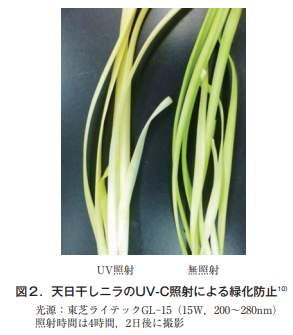
岡山県農林水産総合センター農業研究所の岡氏(野菜・花研究室長)によれば,天日干しの黄ニラでも市場に出すとどうしても弱光に当たるので徐々に緑色を帯びてくるという。このニラにあらかじめUV-C光(200~280nm)を照度5Klxで4時間照射すると少なくとも40時間は全く緑化しない10)(図2)。この反応を見出した時点でこの技術はすでに他社によって特許公開(特開2013- 48615)されていたが,未審査請求による見なし取り下げ〈平成26,11,25〉になっているとのこと。
このUV-Cがクロロフィル生成のどの段階をブロックするのか,筆者の知る限りではその機作は今なお明らかとはなっていないが,核酸の吸収スペクトルのピークがUV-C波長域内にあるので,光が細胞の核酸にダメージを与えクロロフィルだけでなく,あらゆる代謝機能を阻害しているものと考えられる。
(3) Repellent effect on pests of Aster by irradiation with flashing yellow LEDs
私の住んでいる赤磐市の桃園一体は,6月になるとヤガ忌避のため黄緑色の防蛾灯がともる。桃は幼果で,このとき光の影響は全く問題とされない。しかし,日長を感受する作物では問題となる。特にキクでは花の発育に影響するため夜間照明はできない。キク栽培における「開花遅延の回避」と「防蛾効果の発現」を同時に解決するため,石倉11)focused on pulsed light and investigated in detail the effects of pulsed light on bud development in Aster, and demonstrated the usefulness of yellow LED pulsed light. In 2018, they commercialized a flashing LED lamp and verified that it can be applied to tomatoes and spinach in field plots, and concluded that human resource utilization of interpersonal networks through collaboration between researchers and extension workers in the field is necessary to promote this product.12)The importance of information exchange and mutual discussion among stakeholders, as well as sharing the results of research with local needs, is suggested for the wide dissemination of research results. The study suggests that in order to disseminate research results widely, it is important to exchange information and engage in mutual discussions among the parties concerned, and to share the results with local needs through these discussions.
3. in vivo response of flower bud differentiation induced by day length (electric light)
本稿で取り上げたキクの電照は弱光によって花成を制御する技術で,この引き金的な役割を果たすのは,赤・遠赤色光受容体のフィトクロム(phytochrome)であると考えられる。これは分子量約11万の水溶性蛋白質で,図3に示したようにPr型(吸収極大660nm)とPfr型(吸収極大 730nm)で存在し,表記の波長を中心とする光照射で相互に変換するといった特性をもつ。暗所で合成されたPr型フィトクロムは主に細胞質に分布するが,Pfr型に変換されると核内に移行しシグナル因子と相互に作用して特定の遺伝子の発現を調節するとされる。
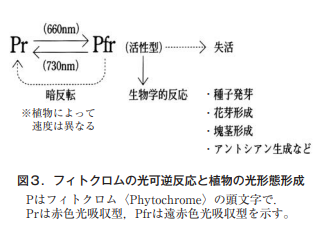
フィトクロムはA, B, Cの3つのグループに大別され,なかでもAは最も光感受性が高く,Pfr型に変換されると暗所で速やかに分解される特性を有する。キクの暗期中断におけるPr型,Pfr型の葉内での動きを,まず図3のフィトクロムの特性に照らして解説すれば以下のようになる。
The short-day plants, onamomi and morning glory, are, to be precise, long-night plants. The long night induces flower development. The morning glory cultivar 'Purple' forms flower buds after a single 16-hour dark period, and the rate at which the flower formation stimulus produced by the leaves moves to the buds was calculated by a clever experiment to be 51 cm/hour.13)The phytochrome theory states that during the long 16-hour night, Pfr-type phytochrome is gradually converted to Pr-type phytochrome (dark reversal in the figure). According to the phytochrome theory, Pfr-type phytochrome is gradually converted to Pr-type phytochrome during the long night of 16 hours (dark reversal in the figure), and flowering is induced when the amount of active Pfr is below a certain limit. Therefore, in a short night, such as 8 hours, Pfr does not fall below a certain limit in short-day plants, and thus flower formation is not induced.
われわれの生活に身近なキクの花成も同様にこの可逆反応により主に制御されていると考えられるが,赤色光で暗期中断を行うとPrがPfrに変換し,Pfrが限界量を超えるので花成は抑えられることになる。ただ,実際には照射時間が3~5時間と長く,赤色に遠赤色を加えても電照効果が変わらない,むしろ効果大とする報告が多く見られることは,図中に記載したPfrの分解による失活が関係するものと推察される。
特にフィトクロムAの量的安定性を保つには,照射時間が長い場合に遠赤色で一部Pr型に変換することにも意味があると考えれば,これも種の生存に向けた光受容体フィトクロムの動的平衡として理解できる。この理由を白山(前報の文献3参照)はフィトクロム作用特性から,キクではフィトクロムAと遠赤色による高照射(エネルギー量が高くなる?)反応が関与している可能性を指摘し,詳細な機構の解明は今後の課題であると記している。
How is the active protein Pfr, which is produced in the leaf, transferred to the subsequent floral development reaction? Recently, genetic studies have revealed that the FT protein produced by the FT gene (Flowering locus T) in Arabidopsis thaliana14)In 2005, this gene was named florigen, a floral growth hormone. Later, it was shown that this FT protein translocated from the leaf to the shoot apex works together with the FD protein present in the shoot apex to turn on the flower bud formation gene (AP1 gene), and the process of making the FT-FD complex was visualized by Abe et al.15)The following is a list of the most common problems with the "C" in the "C" column.
On the other hand, the phenomenon of transition to vegetative growth after induction of non-flowering conditions (even in some leaves), as typified by willow buds in Asteraceae, has been observed in many plants, not only in Asteraceae, suggesting the presence of inhibitors of flower growth in the leaves. Higuchi et al.16)は,2倍体野生キクのFT遺伝子には3種類〈CsFTL1, 2, 3〉あること,このうちFTL3は花成促進に強く働くが,FTL3に拮抗的に作用するAFT遺伝子〈AFT:Anti-florigenic FT/TFL1 family protein〉を発見し,それをアンチフロリゲンと称した。
花成の非誘導条件下の葉〈長日や暗期中断〉で作られるAFTは茎頂に移動して花成を抑制する(図4)。長日から短日に移されるとAFTレベルは急激に減少する一方,FTL3は短日周期が繰り返されることによって徐々に誘導される(図4)。
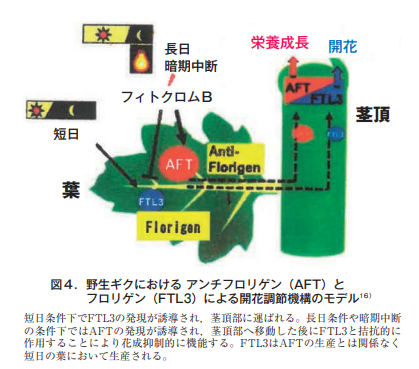
ここでは暗期中断を感知する主要な光受容体としてフィトクロムBがアンチフロリゲン(AFT)の発現を誘導する一方で,フロリゲン(FTL3)の発現を抑制するとしている。ところが,短日下のFTL3の誘導にはフィトクロムBの関与は示されていない。フィトクロムは赤色・遠赤色可逆の色素タンパク質で常に葉に存在しているので,短日でもこのシステムは作動しているはずである。少なくとも最初の短日光周期サイクルではそう言えるであろう。短日下のフィトクロムBの関与が遺伝子レベルで明らかになれば,光レセプターとしてのフィトクロムからFT(FTL3)とAFTへの研究の流れ〈エネルギーの受け渡し〉は,私にはよく理解できるのである。
花成研究の歴史は長く,今や茎頂における遺伝子解析の段階にあるといえる。茎頂分裂組織での質的変換に関係する一連の遺伝子(タンパク質)は,今後も多々発見されるであろうが,それらを農業に利用するためには花器形成まで含めて花芽促進作用を持つタンパク質FTL3様物質の周辺が広く埋まることではないかと思料される。
Conclusion
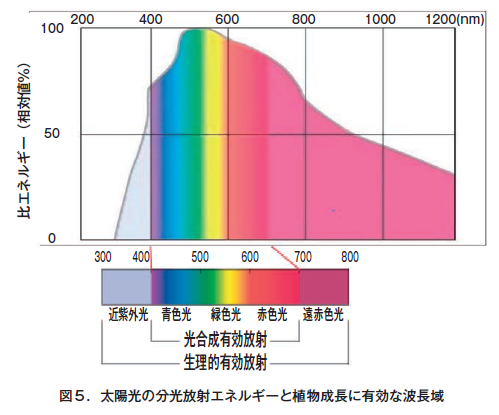
Figure 5 shows the ratio of the radiation energy of sunlight falling on the earth and the wavelength range effective for plants. It can be seen that far-red light at wavelengths above 700 nm is not effective for photosynthesis, but is extremely important for the morphogenesis described in this paper. Light at this wavelength is dim; at 800 nm it becomes an invisible heat ray. The light response of plants can be broadly classified into high-energy reactions for carbonate fixation and low-energy reactions for morphogenesis.
The former is the so-called photosynthesis of 6CO2+12H2O*+ (light energy) → C6indecent12O6+6O*2+6H2O, is a reaction that uses light energy to synthesize sugar from carbon dioxide and water. In potatoes, it is stored as starch in roots and stems, and in fruits, it is accumulated as sucrose and fructose. Some of the sugars are converted to C6indecent12O6+6O2 → 6CO2+6H2O+化学エネルギーで示されるように,生存に必要なエネルギーを産出している。この反応が呼吸で,植物は酸素を使って炭酸ガスと水を放出しているのである。
光合成研究は,岡山大学の沈教授が世界をリードし,水分解反応の機構と酸素の放出に関する画期的な成果を発表されており,理学部のホームページには太陽光エネルギーを利用して水分解反応を人工的に行う「人工光合成」のための触媒創成に重要な基礎を提供するものである,と記されている。
本稿では,後者の低エネルギー反応,とりわけ電照を取り上げたが,一概に電照と言っても,上述してきたようにキクでは花芽分化への質的変換を,イチゴでは矮化抑止への量的拡大を意味し,その目的はキクとイチゴで異なる。花芽形成を促進する点では両者とも夏から秋への短日(長夜)が働く。
キクでは電照により花芽形成が抑制されるが,イチゴでは低温が主要因となって働いているため電照しても花芽形成は続く。ただし,電照時間が長すぎると,つまり長日に過ぎると花芽分化に支障をきたす。イチゴの葉身や葉柄の伸長を促す電照は生育の具合を見て修正する必要があり,キクの電照よりもきめ細やかな技術手法が求められる。葉で感受した短日刺激は茎頂に伝わる。
キクについては,電照や暗期中断によってAFT が強く働きFT(FTL3)遺伝子は抑止され花芽分化は起こらない。一般に植物は,ある一定の齢(相)を経なければ日長を感受して花成を創始することができない。この相を「幼若相」と称するが,この相ではまた別の遺伝子が働いているのであろうか?大変興味ある点であり,また別の機会に論じたい。
イチゴにおいても電照による葉での長日刺激は茎頂に運ばれているはずで,それは少なくとも葉の量的拡大に作用している。イチゴでは植物ホルモンのひとつであるジベレリンの消長が認められているが,葉から送られたタンパク質が茎頂でのジベレリン合成に関係している可能性は多分にある。イチゴの葉で作られるタンパク質が,花成反応とは別に葉の伸長成長にかかわる働きを有していることは確 かで,電照によるイチゴの栄養成長にAFT遺伝子は如何にかかわっているのであろうか?はたして8倍体の栽培イチゴにも AFT様,FT様の遺伝子がキクと同様な機構で存在するのであろうか?
ただ,イチゴの花芽分化には,前報の図9に示したように低温が主導的役割を果たすので,フロリゲン〈日長で誘導される花成ホルモン〉とは異なる仮称未確認バーナリン〈低温で誘導される花成ホルモン〉タンパク質の存在も予想され,一連の研究が農業的価値の高いイチゴ電照の場にも新たな光を灯してくれる,その日の来るのが待たれる。
References
1. Tanedani M., Kato M., Shiiki C., Kagawa H. 2016.Flowering promotion technology of iron stock by far-red light irradiation. Chiba Agricultural and Forestry Research Institute Report 8: 41-50.
2. Kudo Y., Yamaguchi S., Sato A., Kuriyama T., Fukai S. 2012. Effect of electric light on flowering, flower bud blasting and stem elongation in lisianthus wintering in Kumamoto Prefecture. Journal of Horticultural Science 11(3): 363-369.
3.Chiba Prefectural Agriculture and Forestry Research Center. 2019.Improvement of quality of lisianthus in autumn by combining red LED and far-red LED light source. Information on dissemination of experimental and research results.
4. Saitama Flower Promotion Council. 2022. high quality cultivation management technology for November shipment in lisianthus.
5.千葉県農林総合センター.2019.キンギョソウ新品種の特性と電照及び据え置き栽培法.試験研究成果普及情報
6. Iida, H., Hosoyamada, Y., and Takahashi, H. 1989. Prevention of moss abscission in large-leaved shiso (Perilla frutescens L.) by interruption of the dark period. Kyushu Nutrition Research Institute 51: 204p.
7. Narimatsu, J. 1996; Studies on the supplementary light cultivation of spinach. Kanagawa Prefectural Agricultural Research Institute Bulletin 137: 17-23.
8.山崎基嘉.2019.チューブ型赤色LEDを用いた電照による施設ホウレンソウの栽培期間短縮化条件の探索.新近畿中四国農業研究2:46-54.
9.農研機構中央農業研究センター.2019.紫外光照射を基幹としたイチゴの病害虫防除マニュアル~技術編~.1-51.
Establishment of High-Quality and Stable Production Technology for Yellow Chives. (2) Establishment of greening control technology. Okayama National Agricultural Technology Center, Single-year experimental research results. 127-128.
11. Ishikura, S. 2014; Development of pest control technology using yellow LED pulsed light for cut ginkgo. Hiroshima SOKENDAI Agricultural Technology Center Bulletin 90: 1-88.
12. Nishihama, K., Ishikura, S., Hoshino, S., Okada, M., and Ishida, M. 2018. practicality of flashing LED yellow moth lamps in field cultivation plots and the effect of collaboration between research and extension on the quality of extension agents. Hiroshima Soken Agricultural Technology Center Bulletin 92: 11-22.
13.Wareing,P.E. and Phillips,L.D.J. 1970.THE CONTROL OF GROWTH & DIFFERENTI-ATION IN PLANTS.Pergamon Press, Oxford. Chapter10: The physiology of flowering-photoperiodism. 164-195.
14.Kobayashi, Y., Kaya, H., Goto, K., Iwabuchi, M., Araki, T. 1999.A pair of related genes with antagonistic roles in mediating flowering signals.Science 286 : 1960-1962.
15.Abe, M., Kobayashi, Y., Yamamoto, S., Daimon, Y., Yamaguchi, A., Ikeda Y, Ichinoki, H., Notaguchi, M., Goto, K., Araki, T. 2005.FD, abZIP protein mediating signals from the floral pathway integrator FT at the shoot apex. Science 309 : 1052-1056.
16.Higuchi, Y., Narumi, T., Oda, A., Nakano, Y., Sumitomo, K., Fusaki, S., & Hisamatu, T.2013.The gated induction system of a systemic floral inhibitor, anti-florigen, determines obligate short-day flowering in chrysanthemums.Proc. Natl. Acad. Sci. USA 110:17137-17142.
Measures to Prevent Crop and Animal Damage in Aichi Prefecture
Agricultural Promotion Division, Agricultural Policy Department, Agriculture and Fisheries Bureau, Aichi Prefecture
Wild Boar Control Room
辻井 修
Introduction
Crop damage by birds and animals is a common problem throughout Japan. Aichi Prefecture, with its growing urbanization and strong image as an industrial prefecture, is no exception. This section introduces the basics of measures to prevent damage to agricultural crops by birds and beasts, as well as an overview of efforts in Aichi Prefecture.
Basics of measures to prevent damage to crops by birds and beasts
(1) Basic "Three Pillars"
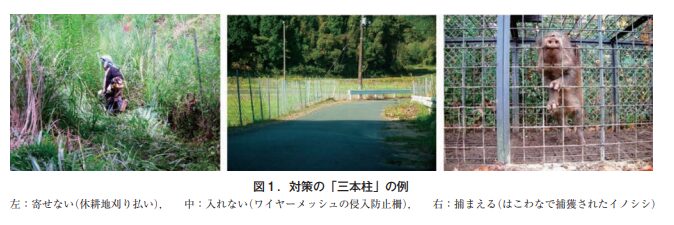
The following three efforts are important in crop damage control, or the "three pillars".
(1) Do not attract: Maintain an environment where it is difficult for birds and animals to perch.
(2) Do not let them in: use fences or nets to prevent entry.
(3) Catch: Capture the assailant
None of this is new, but even today, in the 21st century, there is no other effective way.
(2) Implement in the order of "don't pull in, don't let in, and catch".
「三本柱」は実施順序が重要である。鳥獣対策というとまず捕獲(駆除)を想定しがちだが,捕獲のみ実施してもさしたる効果は得られない。捕獲の前提として,地域の農家・住民による環境管理及び侵入防止対策が必須である。そもそも,農作物を狙う個体をすべて捕獲することは不可能である。農家自身が基本的な対策を実施した上で,捕獲を仕上げに実施するという感覚が望ましい。
(3) Capturing activities are community-wide
In principle, a hunting license is required for trapping, which requires special skills and is also dangerous. Furthermore, in recent years, the shortage of local hunters has become serious. It is becoming increasingly difficult to survive without community-based activities, and the active participation of farmers and local residents is desirable.
3. Aichi Prefecture's Efforts
(1) Damage in Aichi Prefecture1)
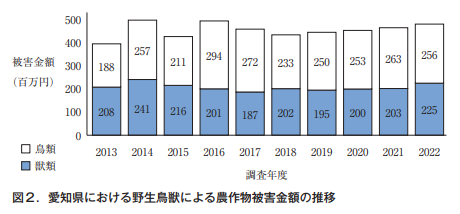
愛知県では,年間4億5千万円前後の農作物被害が発生しており,ほぼ横ばいで推移している(図2)。全国的には被害金額の約80%を獣害(哺乳類)が占めるが,愛知県においては同等か,鳥害の方が多い(図2)。また,園芸作物の被害金額が約65%に達し,野菜や果樹などの園芸作物の生産が盛んな本県農業の特徴を反映していると考えられる。
(2) Measures against wild boars and deer in mountainous areas
In the mountainous areas of central and eastern Aichi Prefecture, damage caused by wild boars and deer is serious. Not only crop damage, but also damage to farmland and farm roads caused by wild boars digging back, traffic accidents, tick infestation, and anxiety over human casualties are problems that cast a shadow over the entire region.
a. Settlement Environment Inspection and Improvement Activities Settlement Environment Inspection and Improvement Activities
In order to put the aforementioned "three pillars" into practice, the environment of the village must first be inspected, and food resources and hiding places must be eliminated.2)The most basic measures are the following. Although these are the most basic measures, not enough efforts have been made in Aichi Prefecture, and unfortunately, this paper cannot introduce any specific examples. In order to preserve the rural environment in mid-mountainous areas, we should aim to strengthen our activities.
b. Maintenance of anti-encroachment fences
Since the 2010s, in Aichi Prefecture, the construction of fences to prevent wild boars and deer from entering villages has progressed with the help of government subsidies (comprehensive measures to prevent damage by birds and animals). The following three points have been proposed as the key points to increase the effectiveness of the project.
(1) Specifications should be able to handle the wild animals that are a problem.
(ii) Close all routes of entry for wild animals.
(iii) Ongoing inspections and repairs
Each of these will be explained.
(1) Specifications should be able to handle the wild animals that are a problem.
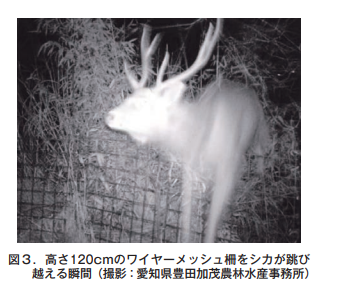
Because of the superior jumping ability of deer, it is necessary to ensure that the fence height is above a certain level. A trail camera installed by the authors captured images of deer jumping over a 120-cm-high wire mesh fence without running (Figure 3). Some have pointed out that 150 cm is sufficient height to prevent deer from jumping over the fence.3),本県の補助事業の仕様ではシカ対策は高さ180cm以上としている。
サルや中型獣(ハクビシン,アライグマなど)は,ワイヤーメッシュ柵単独での侵入防止は不可能である。これらの獣種に対しては,目合いの細かいネットと電気柵を組み合わせる必要がある。電気柵は電圧を維持するための管理が重要となるが,大区画での共同管理では効果の持続が難しい4)。そのため,まずは個別の農家による対策が望ましい。
(ii) Close all routes of entry for wild animals.
It is important to close all potential wildlife entry routes as much as possible with anti-entry fences. Patterns of wildlife entry routes vary depending on geographical conditions and the surrounding environment. In areas where fences have been appropriately installed according to the patterns of entry routes, stable effects have been obtained.
In areas with mountains and hills in the background, with farmlands and urban areas at the foot of the mountains, a certain level of effectiveness has been achieved by installing linear anti-encroachment fences along the foot of the mountains. In this case, the fences were set up along the foothills of the mountains and hills. In this case, rivers and waterways flowing out of the mountains and roads leading to forests cannot be closed and become openings. Roads that are used infrequently (e.g., forest roads) can be closed with gates to stabilize the effect. Along rivers, stairs leading down to the riverbed can be a route of entry, so it is advisable to erect wire mesh at the entrance to the riverbed.
In areas surrounded by mountains and forests, where wild animals enter from many directions, it is desirable to completely enclose the farmland. If the enclosure is incomplete, the wild animals can easily get around and enter the area. In a survey conducted in Chiba Prefecture, it was pointed out that incomplete enclosure is the main factor preventing damage control.5)The first is to enclose as many plots of land as possible in a group. However, it is desirable to enclose as many plots together as possible, since it is inefficient and costly to enclose each brush stroke individually.
(iii) Ongoing inspections and repairs
Fences are not the end of their life; it is important to manage them to maintain their functions. The status of maintenance and inspection differs from village to village, and those areas where frequent activities are carried out are highly effective. Yamahata et al. reported that the social capital indices of the community improved as a result of the continued implementation of animal damage control measures (in this report, monkey chasing activities).6)The same is true of the management of encroachment fences. Similarly, the management of anti-encroachment fences is expected to have the secondary effect of maintaining and strengthening ties among residents.
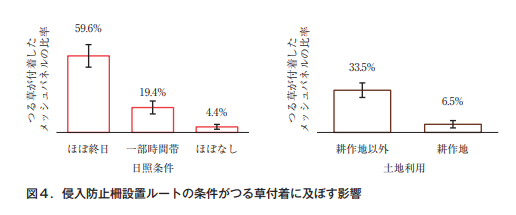
In the management of wire mesh anti-encroachment fences, we often suffer from vine weed infestation. In some studies, kudzu, a typical vine weed, has been reported to grow up to 17 m per year in the second year of germination, and it has been reported that the vine can grow up to 20 m per year in the second year of germination.7)The amount of growth is such that the wire mesh fence is completely engulfed. In an unpublished survey conducted by the authors, it was found that the amount of weed attachment was high in areas with sunny areas and sunny trees (red oak, poison ivy, etc.) and relatively low around agricultural land (Fig. 4). Efficient maintenance and inspection will be possible by taking into consideration the sunlight, vegetation, land use, and other factors.
c. Community-based trapping activities Community-based trapping activities
In order to capture birds and beasts for the purpose of damage prevention, permission from the mayor of the municipality is required, and in principle, a hunting license is required to apply for such permission. For this reason, members of hunters' associations are the main players throughout Japan, and Aichi Prefecture is no exception. It has been pointed out that in the past, there were people who made a living by hunting in Japan's farming and mountain villages, and they secured hunting rights by making a trade-off with hunting to prevent damage to the agriculture and forestry industries.8)The following is a list of the most common problems with the "C" in the "C" column.
近年,狩猟者団体構成員の減少と高齢化による担い手不足が深刻化している。そこで愛知県では,2009年度の豊根村を皮切りに,狩猟免許を持たない地域住民による捕獲補助活動(有害鳥獣捕獲における狩猟免許を有しない従事者容認事業(以下「従事者容認事業」という。))9)The company is working to promote and expand the use of The following advantages may be considered with the introduction of the worker acceptance program.
(1) Workload of trappers will be eased.
The number of traps installed and the management condition of traps will be improved to increase the catch rate.
The participants of the project are expected to train new trappers.
Only when those involved in the effort to prevent damage can the activity be sustained. Farmers' participation in trapping activities, even if it is only a small assistance, is meaningful. It is thought that it will lead to strengthening the cohesion of the community, and active efforts are encouraged.
(3) Measures against crows and medium-sized animals in horticultural farms
Aichi Prefecture is a major producer of horticultural crops such as vegetables and fruit trees, and there are many reports of damage caused by birds and beasts. In particular, damage by birds such as crows and medium-sized beasts such as civets is serious. According to an awareness survey conducted by the Aichi Prefectural Agricultural Experiment Station targeting fruit tree farmers in the prefecture, birds, medium-sized animals, and large animals were the most important in terms of countermeasures, in that order, and it was estimated that medium-sized animals posed a greater threat than the ratio of the amount of damage. The results also indicated that they consider infestation prevention measures to be the highest priority.10)The agricultural extension centers in the prefecture have actually received many consultations from fruit tree farmers regarding damage to birds and medium-sized animals. In fact, the prefectural agricultural extension center receives many consultations from fruit tree farmers regarding damage caused by birds and medium-sized animals, and is working on field demonstrations of practical techniques.
a. Tegus and stainless steel wire to prevent crows from entering
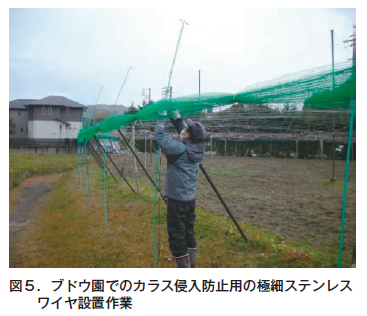
Demonstration results from the National Institute of Agro-Environmental Sciences11)We are currently verifying the use of Tegus stainless steel wires in an orchard to prevent infestation (Figure 5). The installation and management of the wire is a future issue to be addressed. Orchards have a varied surrounding environment, and windbreaks, buildings, and other factors often hinder installation work. Future improvements are expected, such as the use of drones for extending tegus, in addition to minor modifications to the work system.
The verification of the effectiveness of the method in this prefecture has so far been limited to fruit trees with large sales per unit area, such as grapes, pears, and peaches. In the future, it is necessary to study cost-effective methods for fruit trees grown on a larger area, such as oysters and open-air mandarins, and open-air vegetables, such as cabbage and broccoli.
b. Measures to prevent entry of medium-sized beasts
In the cultivation of grapes and other fruit trees with relatively high unit sales prices, Saitama Prefecture has developed a medium-sized beast intrusion prevention facility called "Rakuchi-kun.12)Since April 1, 2017, farmers have been allowed to capture civets, raccoons, and other animals with small spearhooks on their own business land, regardless of whether or not they have a hunting license.13)In addition, the importance of disposal of residues has been pointed out. In addition, since the importance of residue disposal has also been pointed out14)The report calls for appropriate measures to be taken.
(4) Measures to prevent the spread of swine fever in wild boars
In September 2018, the first outbreak of swine fever at a pig farm in Japan in 26 years was confirmed in Gifu Prefecture, and soon after, wild boars in the vicinity were also found to be infected. In Aichi Prefecture, a wild boar infected with swine fever was found in Inuyama City near the border of Gifu Prefecture in December of the same year. Since then, a total of 193 infected wild boars have been confirmed by the end of FY2023, and there is still no end in sight. Currently, the following measures are being implemented.
A. Wild boar inspection Wild boar inspection
Blood and other specimens are collected from captured wild boars and tested for viral genes by real-time PCR at a laboratory. Some of the specimens are also tested for antibodies, and the acquisition of immunity against swine fever virus is also investigated. The results are shared with relevant personnel and used as basic data for the oral vaccine and enhanced capture measures described below.
b. Field spraying of oral swine fever vaccine
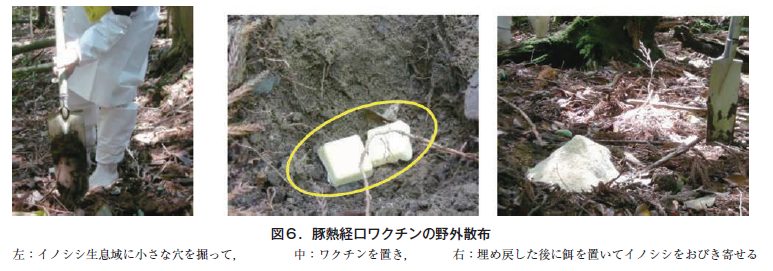
To immunize wild boars against swine fever virus, a precedent in European countries.15)The oral vaccine is a preparation consisting of liquid vaccine capsules containing attenuated virus wrapped in food consisting of corn flour and oil or fat. The oral vaccine is a preparation consisting of a capsule of vaccine solution containing attenuated attenuated virus wrapped in food consisting of corn flour and oil, which is buried underground in the habitat of wild boars and fed to the animals (Fig. 6).
c. Enhancement of capture
Increased subsidies for capture activities have been provided to increase motivation for such activities, and intensive capture activities have been conducted by certified bird and wildlife trappers in wildlife sanctuaries, national forests, etc.
4. Conclusion
Aichi Prefecture also disseminates information on its website and SNS regarding measures to prevent damage to birds and animals and the spread of swine fever among wild wild boars (Fig. 7).
5. references
(1)愛知県農業水産局.野生鳥獣による農作物被害の状況(2022 年度).2023
(2)農林水産省.野生鳥獣被害防止マニュアル -総合対策編-.2023
(3)堂山宗一郎.ニホンジカはどのようにして柵内に侵入するのか?.JATAFFジャーナル7.2019
(4)長門勇治,吉仲怜.鳥獣被害対策における電気柵管理の実態と方向性.農業経営研究49.2011
(5)村松広貴ら.防護柵の延伸がイノシシによる水稲被害軽減に直結しない理由.野生生物と社会7.2019
(6)山端直人ら.獣害対策の継続が集落のソーシャル・キャピタルに及ぼす影響.農村計画学会誌34.2015
(7)岡崎(田中)麻衣子ら.クズ(Puerarialobata(Willd.) Ohwi)登攀茎の生長と莢生産.日緑工誌43.2018
(8)高橋満彦.鳥獣法の根本は変わるのか…2014年法改正を題材に.ワイルドライフフォーラム春夏号.2014
(9)松尾浩司(環境省).狩猟免許を有しない従事者制度の概要.地域ぐるみで取り組む鳥獣被害対策に関する研修会発表資料.2013
(10)辻井修ら.階層分析法による果樹の鳥獣対策に関する感性的評価.愛知農総試研報53.2021
(11)農研機構・鳥獣害管理プロジェクト.果樹園のカラス対策「くぐれんテグス君」設置マニュアル.2013
(12)埼玉県農業技術研究センター.楽落ライト設置マニュアル.2018
(13)環境省.鳥獣の保護を図るための事業を実施するための基本的な指針(平成28年10月告知版).2016
(14)小坂井千夏.廃果場,エネルギー獲得効率の高い鳥獣の餌場-鳥獣害防止に向けて必要なこと-.JATAFFジャーナル7.2019
(15)Sophie Rossi et al. Controlling of CSFV in European wild boar using oral vaccination: a review. Frontiers in Microbiology6. 2015
土のはなし-第31回
危機に瀕する世界の土-その1
古代文明の崩壊と土の劣化
前 ジェイカムアグリ株式会社
北海道支店 技術顧問
松中 照夫
From the 25th to the last issue of this series, it has been stated that agriculture can have a negative impact on the environment, depending on how it is conducted. Therefore, it is important to conduct agriculture in an environmentally friendly manner. This is because agriculture cannot be stopped because it produces food for people.
Soil is what supports crop production in agriculture. However, the phenomenon of soil degradation, in which the soil becomes degraded and unsuitable for crop production, is spreading on a global scale, and one-third of the soil has already been degraded (Silva, 2014). The soil is indeed in danger. We will explore the current situation and causes of soil degradation in this article.
1. indifference to the soil will destroy civilization
About 10,000 years ago, primitive man acquired the wisdom to secure food through agriculture. Once the foundation for stable food production was established through agriculture, the ability to support the population increased. Ironically, however, it also made it impossible to return to a hunter-gatherer lifestyle. The food supply of the increased population could no longer be supported by hunting and gathering. The agricultural and sedentary lifestyle gradually flourished as people left the natural ecosystem, created artificial ecosystems, and built settlements. This is where the seeds of ancient civilization were planted.
しかしこの文明の繁栄は,30から70世代(800 から2000年)以上長続きすることはなかった。その根本原因は,自然生態系を無視し,土の肥沃度維持に無関心だったため,食料を持続的に生産できなくなったことにあると,カーターとデール(1975)はその名著「土と文明」で指摘している。
彼らの指摘の一部を以下で見てみよう。
1) The Fertile Crescent, an example from Mesopotamia
The "Fertile Crescent" refers to the lowlands in the basin of the Tigris and Euphrates Rivers, from their upper reaches to the Jordan River basin and the Dead Sea. In the past, this area had fertile soil that was even called "a land flowing with milk and honey. This area has low precipitation.
Therefore, irrigation from the Tigris and Euphrates rivers was essential for crop cultivation. The Armenian plateau, located upstream of both rivers, was richly forested. However, when civilization inspired people to gather there, the forests were cut down for fuel and building materials, and livestock were overgrazed. The soil on the plateau, which had lost its forests, could no longer hold water, and the topsoil eroded, causing sediment to flow into rivers and accumulate in irrigation canals. The function of the irrigation canals was maintained by the removal of sediment by slave labor.
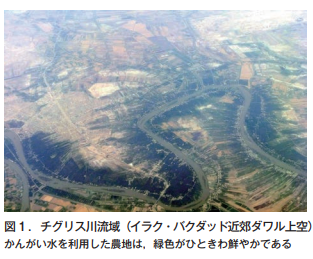
However, the peoples attacking Mesopotamia were indifferent to the irrigation canals. Eventually, the irrigation canals were blocked by earth and sand, rendering them unusable. The decisive blow came when the nomadic Mongols attacked the region. The nomads did not understand the importance of irrigation and completely destroyed the canals. Even worse, in this region of high evaporation, when irrigation connected the groundwater to the surface, a tremendous amount of salt was introduced and accumulated on the surface, causing the soil to become salinated. This salinization completely destroyed the soil's ability to produce crops.
Waterways for irrigation water, which is essential for food production, were filled with soil and sand, and the soil was easily salinized.These factors made it difficult for Mesopotamia to sustain a stable supply of food and reduced its ability to support its population. Thus, civilization declined.
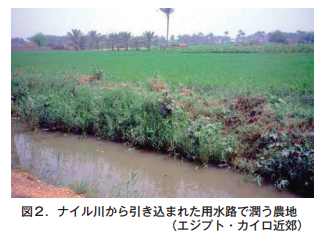
(2) Example of the Nile River Basin, Egypt
Maintaining soil fertility by taking advantage of nature: The situation in the Nile River basin in Egypt is different from that in Mesopotamia, even though they are the cradle of the same ancient civilization. The Nile River rises and falls every year in precise cycles. This is because the main source of water was melted snow from the Ethiopian plateau and the highlands of Central Africa. The floods, which always came once a year in the summer, brought harvests to ancient Egypt.
First, an enclosure is built along the Nile River basin, similar to the footpath between rice paddies. In this enclosure, muddy water that overflows during the flooding season is stored like rice paddies before planting (called flooded irrigation). After a few weeks of irrigation, the fertile silt (fine sand) contained in the muddy water settles on the ground, and the water permeates the soil sufficiently. The excess water is then drained away, and wheat and other seeds are sown in the fertile muddy soil. People of that time, who thought in harmony with nature, did not try to conquer the enormous water energy of the Nile during the flooding season. Rather, they established a waterlogging irrigation technique that made good use of nature. However, this technology also had its drawbacks. It was a weakness in that it could only be planted once a year during the period of the Nile's rising waters.
通年かんがいへの転機:19世紀以降になると,エジプトでは綿花の輸出が計画された。しかし,綿花はナイル川の減水期(3~4月)に播種され, 10月に収穫される夏作物である。このため,増水期の水を利用できない。そこで,減水期の低い水位の水を利用するため,深いかんがい用運河が掘られた。こうして,ナイルの水量の増減に関係なく,水を通年利用する環境が整った。
この通年かんがいへの熱い思いが,後の1903年,イギリスの援助によるアスワンダムを完成させた。このダムの利用で安定した農業生産が約束された。そのおかげで人口が大きく増え,1882年に 700万人だった人口が,70年後の1952年には2,000 万人に達した。ところが,人の生活のための土地利用が進むと,原流域の山林が伐採され,家畜の過放牧もはじまった。
こうした土地利用の変化で,ダムに運ばれる土砂が多くなり,ダムは土砂で徐々に埋められ,貯水機能が低下した。 ダムの機能低下はかんがい不能をもたらし,作物生産の減少につながった。そこでアスワン・ハイダムの建設が,ソビエト(現在のロシア)の援助で1960年に着工,10年後に完成した。これによって通年かんがいの農地ができ,作付けも年に数回可能となり,作付面積が大幅に拡大した。
The merits and demerits of dams and the order of nature: The completion of the Aswan High Dam seemed to have solved the water problem. However, aquatic snails began to proliferate in the irrigation canals, and the parasite Birkhartz's blood-sucking worm began to spread, using the snails as intermediate hosts, and the soil began to become salinated.
The annual Nile floods wash away the salts that tend to accumulate on the earth's surface. Moreover, they carry nutrient-rich fertile silt from upstream and deposit it on top of the old soil. This naturally overcame the salinization of the soil and maintained its fertility. This was the ancient natural order of things that supported the "fertile lowland soil of the Nile.
In modern times, however, people have attempted to control the flow of the Nile themselves. The Aswan High Dam, which was supposed to have been built to stabilize agriculture, caused salt damage and parasites. This is a tragedy of irrigated agriculture that failed to take advantage of the natural order of things.
2. how to apply lessons learned
What the decline of ancient civilizations teaches us is the fact that without preserving the soil, the foundation of food production, there can be no food security and no advanced civilization can be sustained. The collapse of civilization due to resource depletion on the isolated Pacific island of Easter Island also offers valuable lessons for us today (Ponting, 1994). The question for us today is how to apply these lessons.